

It was 11 PM on a Tuesday when I got the call. A client’s bookkeeper had quit mid-year, and a CRA production request had just landed. The business had six weeks of unfiled GST/HST returns, source documents scattered across three email accounts, a shoebox of expense receipts, and a bank feed nobody had reconciled since March. The records technically existed. Finding them, matching them, and proving anything? That was a different story entirely.
Every GST/HST registrant in Canada must keep books and records that support their filed returns—including sales invoices, purchase invoices, expense receipts, and working papers—for a minimum of six years from the end of the tax year they relate to. The CRA expects these records to be available in Canada and detailed enough to verify GST/HST collected, Input Tax Credits claimed, and net tax reported on your GST34.
By the end of this guide, you’ll have a complete, practitioner-tested system for organizing, maintaining, and retrieving your GST/HST records—so you never end up scrambling at 11 PM.
Why GST/HST Record Keeping Goes Beyond Compliance
Good GST/HST record keeping isn’t about satisfying the CRA—it’s about running your business without unnecessary friction. Proper records support accurate ITC claims, faster month-end closes, cleaner financial statements, and less stress during filing periods.
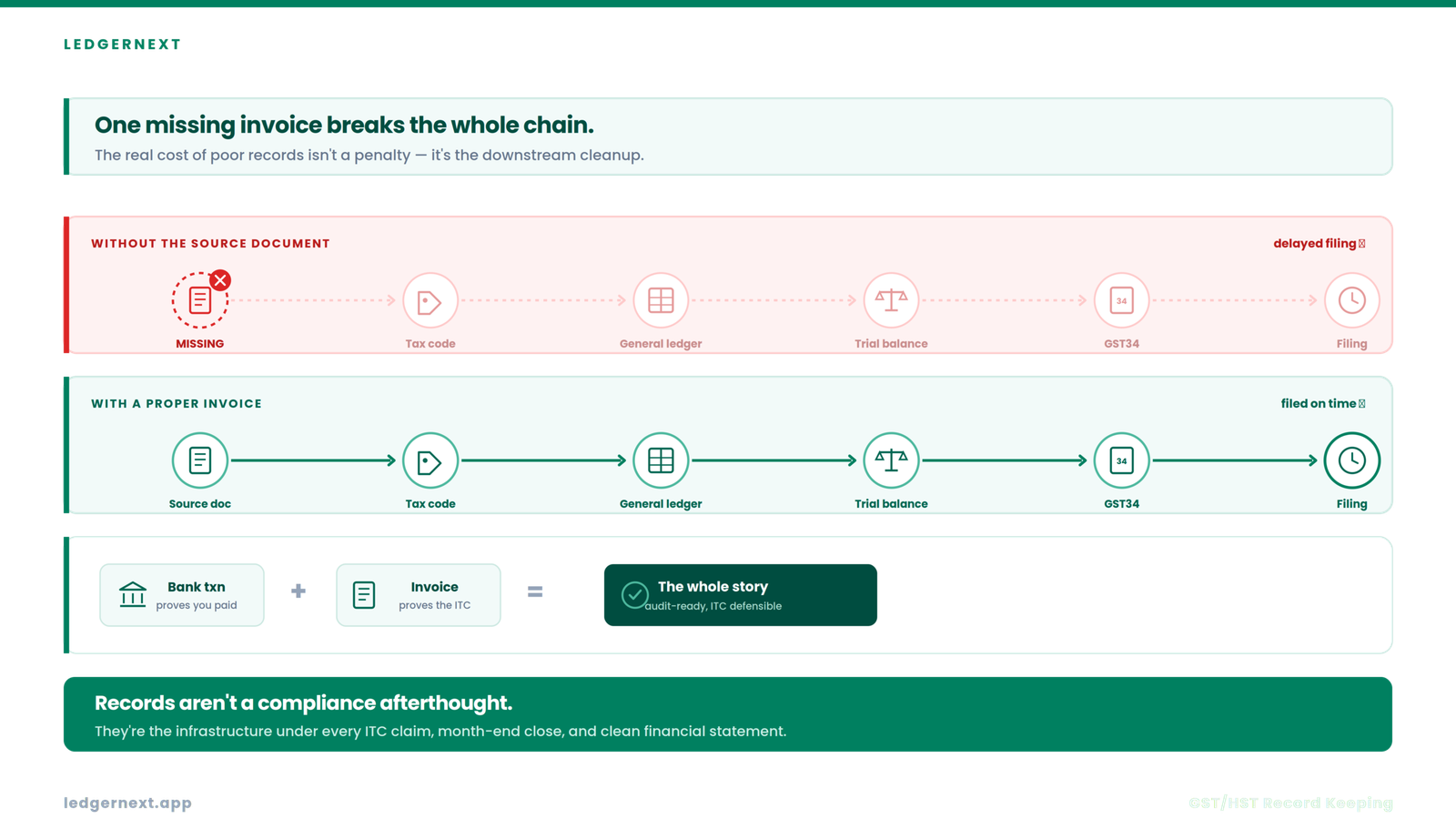
Here’s what most guides won’t tell you: the real cost of poor records isn’t a CRA penalty. It’s the hours your accountant spends reconstructing what should have been organized from the start.
When source documents are missing or incomplete, your bookkeeper can’t categorize transactions with the right tax codes. That creates downstream problems in your general ledger, your trial balance, and ultimately your GST34. One missing supplier invoice can trigger a chain of reconciliation issues that delays an entire filing.
“A bank transaction proves you paid. A proper invoice proves you’re entitled to the ITC. Without both, you have half a story.”
📌 Key Takeaway: Record keeping supports every financial workflow in your business—from bank reconciliation to financial reporting. Treat it as operational infrastructure, not a compliance afterthought.
What the CRA Actually Expects from Your Records
The CRA requires every GST/HST registrant to maintain records sufficient to determine their obligations and entitlements under the Excise Tax Act. Records must be kept in English or French, stored in Canada (or made available in Canada upon request), and retained for six years from the end of the relevant tax year.
What surprises most business owners is how specific the documentary requirements are. For ITC claims, the CRA doesn’t just want proof you spent money. They want invoices showing:
- Supplier name and Business Number (BN)
- Date of the transaction
- A description of the goods or services
- The GST/HST amount charged (or a statement that tax is included)
- The total amount paid
The threshold matters too. Purchases under $30 have simplified requirements. Between $30 and $150, you need the supplier’s name, BN, and the tax amount. Above $150, you need the buyer’s name or trading name as well.
Operational insight: I’ve reviewed hundreds of client files where the invoice existed but was missing the supplier’s GST/HST registration number. That single missing field can make an ITC indefensible during a CRA review.
Essential Records Every Business Should Maintain
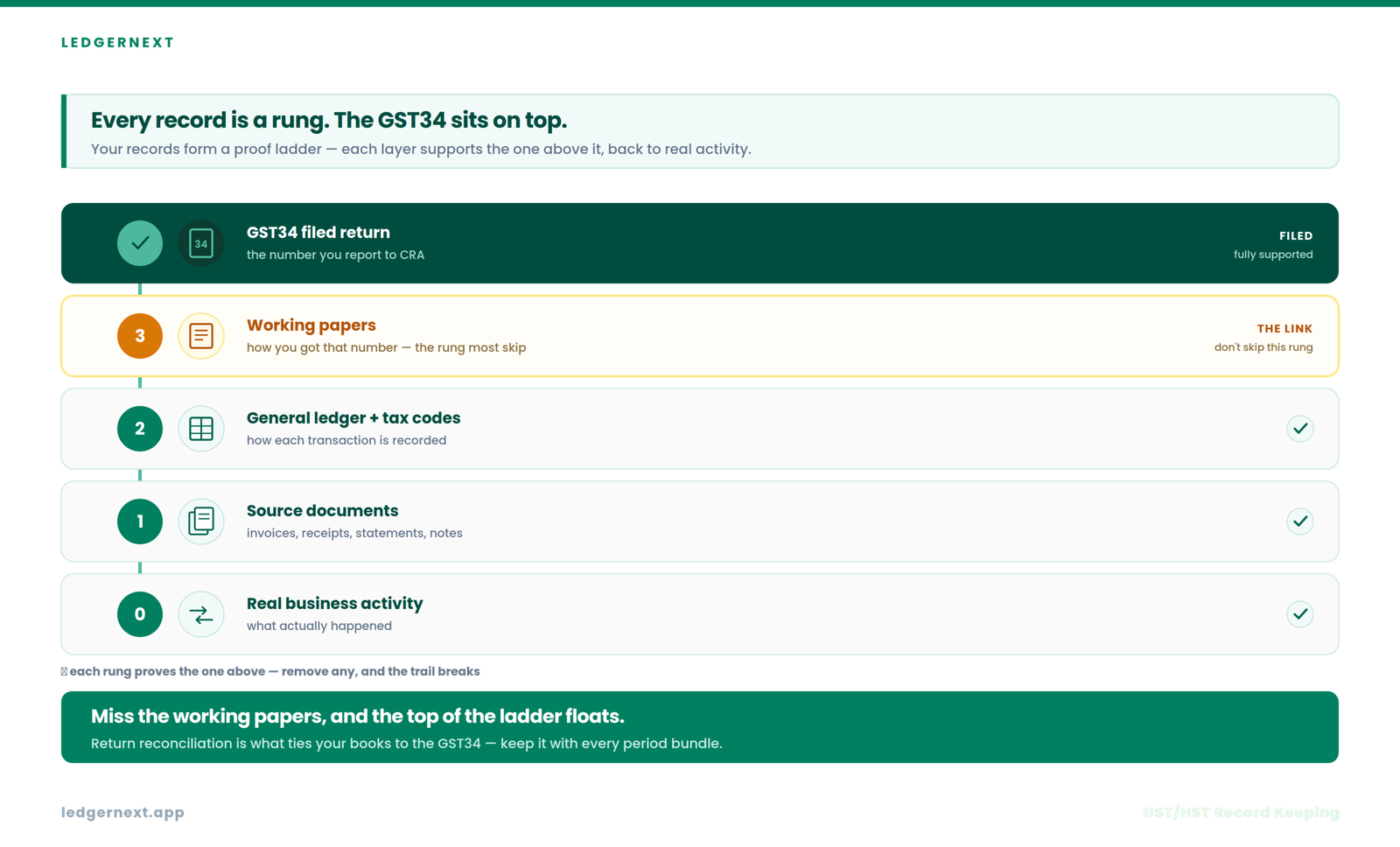
Every GST/HST registrant should maintain a core set of documents organized by reporting period. These records form the audit trail that connects your filed returns to your actual business activity.
Core records include:
- Sales invoices issued to customers (showing GST/HST collected)
- Purchase invoices from suppliers (supporting ITC claims)
- Expense receipts for business purchases
- Bank statements and payment records
- General ledger entries with proper tax codes
- GST/HST return copies (GST34) and working papers
- Contracts and agreements affecting tax treatment
- Credit and debit notes for adjustments
- Import/export documentation where applicable
The record most people forget: working papers. Your return reconciliation—the spreadsheet or report that ties your books to the numbers on your GST34—is just as important as the invoices themselves. If you can’t show how you arrived at your net tax figure, the supporting documents lose context.
For a deeper understanding of how these records connect to your financial structure, see our guide on Chart of Accounts Explained.
Physical vs. Digital Records: What the CRA Accepts
The CRA accepts electronic records, provided they are accessible, readable, and can be produced in Canada when requested. Digital records must maintain the same level of detail as paper originals and be stored in a format that allows CRA officials to review them.
| Factor | Physical Records | Digital Records |
|---|---|---|
| CRA Acceptance | Yes | Yes, with conditions |
| Retrieval Speed | Slow (manual search) | Fast (searchable, indexed) |
| Storage Cost | Higher (physical space) | Lower (cloud-based) |
| Disaster Risk | High (fire, water, loss) | Lower (with proper backups) |
| Audit Response | Slower | Faster |
| Searchability | Limited | High (OCR, naming conventions) |
Practical recommendation: If you’re scanning paper receipts, don’t just dump them into a single folder. Name files using a consistent convention—something like ClientName_Vendor_Amount_Date.pdf—so you can retrieve any document in under a minute. That sounds like overkill until a CRA request lands and you’re searching through 2,000 unnamed PDFs.
Original insight #1: Consistent naming conventions do more for audit readiness than any single piece of software. The firms I’ve seen respond fastest to CRA requests aren’t necessarily using the fanciest tools—they just have disciplined file hygiene.
Record Retention: The Six-Year Rule and Its Exceptions
Canadian businesses must retain GST/HST records for at least six years from the end of the tax year to which they relate. You cannot destroy records before this period ends unless you receive written permission from the CRA.
When the clock starts matters. If you file a GST/HST return for Q1 2024, the six-year retention period begins at the end of your 2024 fiscal year—not the date you filed the return.
A few situations extend the retention period:
- If you’ve filed an objection or appeal, keep records until the matter is resolved and the normal period expires
- If the CRA has not yet assessed a return, keep records until assessment plus six years
- Capital property records should be retained for six years after disposition
Original insight #2: I’ve seen businesses delete records at exactly the six-year mark without checking whether all related assessments were finalized. If a reassessment is pending, you’ve just destroyed your own defense.
Common GST/HST Record-Keeping Mistakes
Most record-keeping failures aren’t dramatic. They’re quiet, accumulating gaps that only surface during a CRA review or year-end close.
The mistakes I see most often:
📌 Key Takeaway: Pick five random GST/HST expense transactions from last quarter. If two or more are missing a proper receipt or invoice, your records aren’t audit-ready.
The RECORD Framework™ for GST/HST Compliance
After years of managing multi-client GST/HST workflows, I developed a framework that addresses the operational gaps most compliance checklists ignore.
Don’t assume bank records are enough. For every transaction affecting GST/HST, retain the source document—invoice, receipt, contract, or credit note—that supports the tax treatment.
Use standardized tax codes across all clients and periods. When categorization is inconsistent, your trial balance and financial statements inherit those errors.
One system. One location. Whether it’s accounting software, a document management platform, or a structured cloud folder, stop scattering records across email threads, desktop folders, and shared drives.
Every document should be retrievable by the reporting period it belongs to. When CRA asks about Q3 2023, you should be able to pull that entire period’s file bundle in minutes.
Complete your bank reconciliation and GST/HST control account reconciliation before preparing your GST34. Return reconciliation catches misclassifications, missing entries, and tax code errors before they become filed mistakes.
Every manual adjustment, reclassification, or unusual transaction needs a note explaining what was changed and why. Future-you (or your auditor) will need that context.
Best Practices for Accounting Firms Managing Multiple Clients
If you’re running a firm handling dozens of client files, the challenge multiplies. Here’s what separates firms that file on time from firms that scramble every quarter.
Build document collection into recurring workflows. Don’t wait until filing time to chase receipts. Include document requests in your month-end close checklist so gaps are identified weekly, not quarterly.
Standardize your client intake checklist. Every client should provide the same document set each period: bank statements, sales invoices, purchase invoices, expense receipts, and payroll summaries. When the request is consistent, clients learn the rhythm.
Original insight #3: The firms I’ve seen operate most efficiently don’t have better clients—they have better systems for requesting documents. A standardized, recurring document request reduces back-and-forth by weeks over a fiscal year.
Reconcile GST/HST control accounts monthly. Waiting until year-end to reconcile means you’re untangling twelve months of accumulated errors. Monthly reconciliation keeps each period clean and makes the GST/HST filing checklist a formality rather than a fire drill.
How Technology Simplifies GST/HST Record Keeping
The right accounting software eliminates the manual friction that causes most record-keeping failures. Automated transaction matching, built-in tax code assignment, and real-time reporting reduce the gap between “records exist” and “records are organized.”
Original insight #4: Digital records reduce retrieval time, but only if they’re searchable and properly categorized. Technology without discipline just creates a bigger, faster mess.
Modern platforms can flag transactions missing tax codes before you file, generate period-specific reports aligned to your GST34, and maintain a continuous audit trail from bank feed to financial statement.
Streamline Your GST/HST Record Keeping
We built LedgerNext to handle exactly the workflow challenges described in this guide. The platform generates GST/HST Summary reports aligned to the GST34, flags missing tax codes before filing, supports province-specific tax setup, and produces clean general ledger, trial balance, and financial reports—all exportable and organized by reporting period. For firms managing multiple clients, it centralizes everything into one dashboard with ITC tracking built in.
Frequently Asked Questions
What GST/HST records must Canadian businesses keep?
Every GST/HST registrant must keep sales invoices, purchase invoices, expense receipts, bank statements, general ledger entries, filed return copies, and working papers. Records must contain enough detail to verify GST/HST collected, ITCs claimed, and net tax reported. The CRA specifically requires invoices to include the supplier’s Business Number and the tax amount.
How long should GST/HST records be retained?
Canadian businesses must retain GST/HST records for a minimum of six years from the end of the fiscal year they relate to. Records for capital property should be kept for six years after the property is disposed of. Never destroy records while an objection, appeal, or reassessment is pending.
Does the CRA accept digital records?
Yes. The CRA accepts electronic records provided they are accessible, complete, readable, and can be produced in Canada when requested. Digital records must contain the same information as paper originals. Storing records in the cloud is acceptable, but you must be able to produce them on demand.
What happens if GST/HST records are missing?
Missing records can result in disallowed ITC claims, reassessments, penalties, and interest. If you cannot produce supporting documentation during a CRA review, the burden of proof falls on you. The CRA may estimate your tax liability based on available information—which rarely works in your favour.
What documents support Input Tax Credit claims?
ITC claims require invoices showing the supplier’s name, BN, transaction date, description of goods or services, GST/HST charged, and total amount. For purchases over $150, the buyer’s name must also appear. Without compliant invoices, ITCs can be denied even when the expense is legitimate. (See also: Input Tax Credits Explained for Canadian Businesses)
Practical GST/HST Record-Keeping Checklist
Use this checklist at every reporting period:
Where to Go from Here
The gap between “we keep records” and “we keep records that actually work” is where most GST/HST stress lives. Compliance isn’t the hard part. Building a system that makes compliance automatic—that’s the real work.
Start with the RECORD Framework™. Pick the weakest link in your current workflow—whether it’s centralization, reconciliation, or just getting clients to send their receipts on time—and fix that one thing this month.
Your GST/HST records should work for you during every month-end close, not just when the CRA comes calling.